 %
%
 %
%
You find a strain you love.
Perfect smell. Great flavour. Exactly the kind of high you were looking for.
So naturally, you buy it again.
Same strain name. Same genetics. Maybe even the same grower.
Then you smoke it and think: Wait... is this actually the same weed?
It probably is.
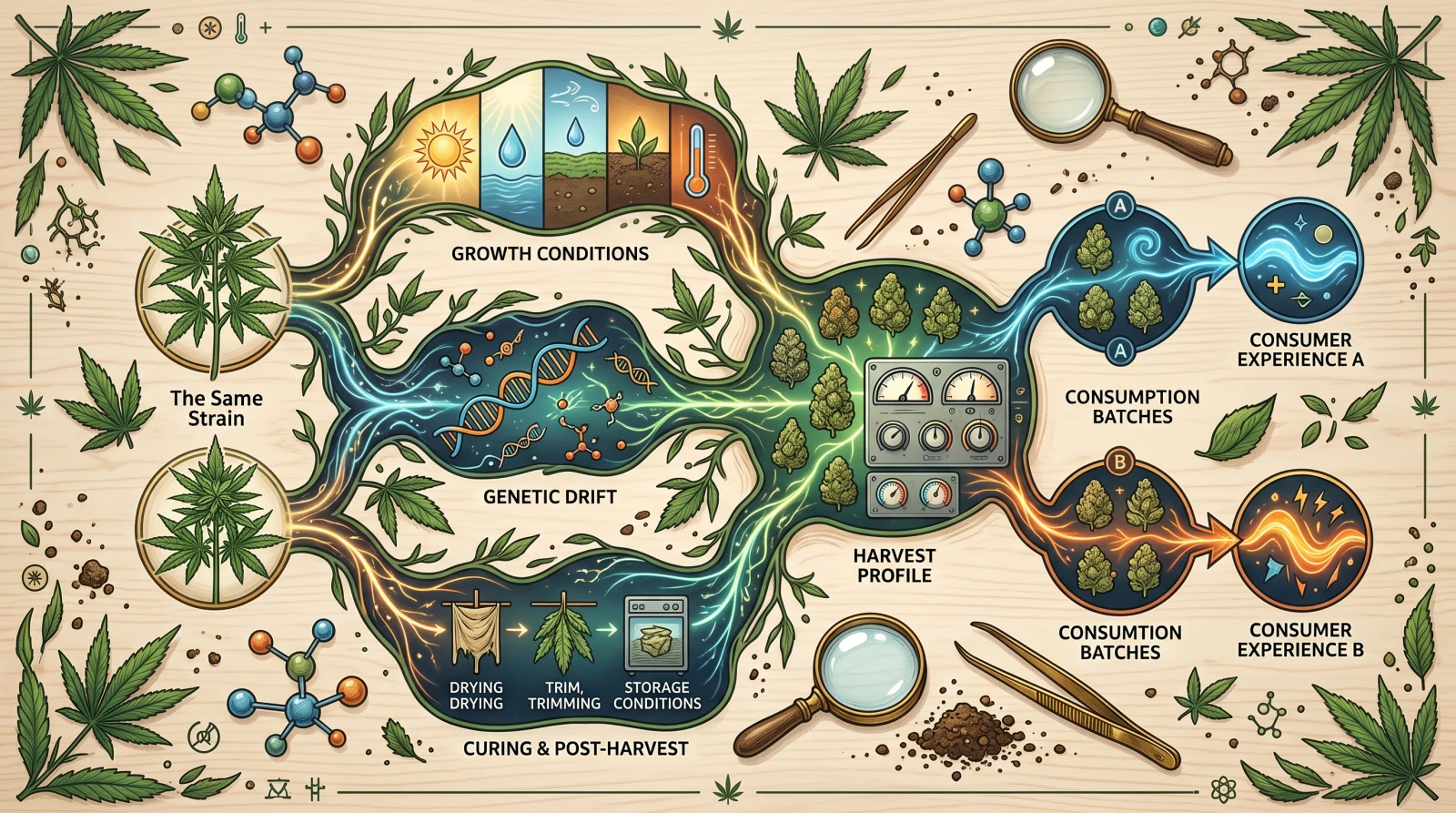
Cannabis just isn't manufactured like a can of Coke. Flower is an agricultural product, and one batch can differ from the next depending on how it was grown, when it was harvested, how it was dried and cured, and what happened to it before it reached your jar.
That's why your favourite strain can be incredible one month and merely decent the next.
Let's get into what actually changes between batches, what those differences mean when you're shopping for cannabis flower, and how to spot a good batch before you've already rolled it.
Same Genetics Doesn't Mean Identical Weed
A strain name describes genetics.
It doesn't guarantee an identical finished product.
Think about tomatoes.
You can grow the exact same variety of tomato in two gardens and end up with noticeably different results depending on sunlight, temperature, soil, nutrients, watering, harvest timing, and the person growing them.
Cannabis works the same way, except there are even more variables after harvest.
Two batches from the same cultivar can differ in:
THC and cannabinoid levels
Terpene concentrations
Bud structure
Moisture
Aroma intensity
Flavour
Trichome development
Smoothness
And, ultimately, how the experience feels to you.
The same cannabis strain can hit differently between purchases because flower is an agricultural product. Growing conditions, phenotype, harvest timing, drying, curing, storage, and batch age can all change the final product.
The name on the bag is the starting point.
The batch inside is what you're actually smoking.
Harvest Timing Can Change the Final Product
Cannabis plants don't suddenly become "ready" at exactly 9:00 AM on harvest day.
There's a window.
Growers monitor plant maturity and trichome development to determine when it's time to harvest. Harvesting at different points within that window can influence the cannabinoid and terpene profile of the finished flower.
Even plants with identical genetics aren't necessarily developing at exactly the same speed.
One harvest might be allowed to mature a little longer than another. Environmental conditions can also speed up or slow down development.
This doesn't mean one batch is automatically better.
It means harvest timing is one of many reasons two batches aren't chemically identical.
And once the plant comes down, another major variable enters the picture.
The Cure Can Make or Break Good Flower
Growing beautiful cannabis is only half the job.
Then you've got to dry and cure it properly.
Freshly harvested cannabis contains significant moisture. Drying removes much of that moisture, while curing allows the flower to stabilize gradually under controlled conditions.
Done well, the process helps preserve aroma, flavour, and an enjoyable smoking experience.
Done badly?
Even excellent genetics can become disappointing.
Too Dry
Flower that's dried aggressively can become brittle and harsh.
Terpenes are volatile, meaning some can be lost during poor drying and storage conditions. If a batch has been overdried, opening the bag may produce considerably less aroma than you remember from your previous purchase.
Too Wet
Flower that's improperly dried can burn poorly and may create storage problems.
Excess moisture also raises a much more serious concern: mould.
Just Right
Good flower should generally feel properly cured rather than wet or crispy.
The bud should have some resilience when gently squeezed. It shouldn't turn into powder immediately, and it shouldn't feel damp.
That's why two purchases of the same strain can feel completely different before you've even taken the first hit.
Terpenes Don't Stay Frozen in Time
Remember how the same strain smelled ridiculously loud the first time you bought it?
You cracked the bag and immediately got gas, citrus, fruit, earth, or whatever profile made you go back for more.
Then the next batch smells... quieter.
That's not necessarily your imagination.
Terpenes contribute heavily to cannabis aroma and flavour, and they're volatile compounds. Their concentration and preservation can be affected by genetics, growing conditions, harvest timing, drying, curing, heat, light, oxygen, and storage.
That means two batches carrying the same strain name can have noticeably different aromatic intensity.
Maybe you thought you loved one specific strain.
What you really loved might have been its gassy caryophyllene-heavy profile or its bright citrus character.
Once you know that, finding alternatives becomes easier when your favourite batch isn't hitting the same.
Phenotypes Make Things Even More Interesting
Here's where cannabis genetics get a little more complicated.
Seeds from the same strain can produce plants with different expressions of their genetics. These variations are commonly called phenotypes.
Think of siblings.
Same parents.
Definitely related.
Not identical.
One phenotype might grow taller. Another may produce denser buds. One can lean toward a sweeter aroma while another expresses more gas or earth.
Growers often select a particular plant they like and preserve it through cloning, which helps create greater consistency.
But even clones aren't magic photocopiers.
A genetically identical cutting grown under different environmental conditions can still produce flower with meaningful differences.
So genetics matter enormously.
They just aren't the only thing that matters.
The Grow Room Changes the Outcome
Cannabis responds to its environment throughout its entire life cycle.
Variables can include:
Light intensity and spectrum
Temperature
Humidity
Nutrients
Watering
Airflow
Growing medium
Plant stress
Pest management
Harvest timing
Change those variables and you can change how the plant develops.
That's why two growers working with similar genetics can produce flower that looks, smells, tastes, and smokes differently.
It's also why you shouldn't assume you've experienced everything a strain has to offer after trying one mediocre version of it.
Maybe you don't dislike the genetics.
Maybe you disliked that particular batch.
THC Percentage Can Change Between Batches Too
Let's say the first batch of your favourite strain was labelled 27% THC.
The next comes in at 23%.
Is somebody messing with you?
Not necessarily.
Cannabinoid levels naturally vary between harvests.
Even flower from different parts of the same plant isn't perfectly identical, never mind flower grown during different cycles.
That's one reason chasing a strain purely because you remember a particular THC number can be misleading.
A four-percentage-point difference doesn't automatically tell you which batch you'll enjoy more.
Terpenes, minor cannabinoids, freshness, cure, your tolerance, your dose, and your own biology all contribute to the experience.
If potency is specifically what you're shopping around, you can browse the High THC collection and compare what's currently available rather than assuming a familiar strain name will always land at the same percentage.
A higher THC percentage doesn't automatically mean a better batch. Aroma, freshness, cure, terpene preservation, dose, and your personal response can matter just as much to the overall experience.
Storage Changes Weed After It Leaves the Grower
Let's say the grower absolutely nailed it.
Harvest was on point.
Drying went perfectly.
The cure was beautiful.
That still isn't the end of the story.
Cannabis continues changing during storage.
Heat, oxygen, light, excessive dryness, and time can all affect flower quality. A fresh batch stored properly may arrive aromatic and slightly springy, while older or poorly stored flower can become dry and muted.
That's why freshness matters.
It's also why your previous purchase isn't necessarily a fair benchmark if you've been keeping that jar beside a sunny window for three months.
If your flower has already become brittle, our guide on [how to rehydrate dry weed](/blog/how-to-rehydrate-dry-weed) explains what moisture restoration can and can't fix.
Spoiler: you can put some moisture back.
You can't resurrect terpenes that already left the building.
Does Different-Looking Bud Mean It's a Different Strain?
Not automatically.
Bud appearance can vary between batches too.
You may notice changes in:
Bud size: One batch might contain large tops while another contains smaller buds.
Colour: Growing conditions, phenotype, maturity, and post-harvest handling can influence appearance.
Density: Some harvests may produce tighter flower than others.
Trichome coverage: Visible resin production can vary.
Trim: Different trimming and handling can change how polished the finished buds look.
Some differences are perfectly normal.
But if a strain you've bought repeatedly suddenly looks, smells, and tastes completely unrelated to previous batches, asking questions is reasonable.
A strain name shouldn't be treated as a guarantee of perfect consistency.
It also shouldn't be meaningless.
Indica, Sativa, and Hybrid Labels Don't Solve the Problem
Maybe you avoid all this by buying the same indica every time.
Unfortunately, no.
Batch variation happens across cannabis categories.
You can browse [Indica strains](/shop/indica), [Sativa strains](/shop/sativa), or [Hybrid strains](/shop/hybrid), but those labels don't eliminate agricultural variation.
They're broad navigation tools.
The individual batch still matters.
The same applies to more flavour- or genetics-driven collections such as Gas Strains and Pink & Exotic Strains.
A Pink strain can be fantastic in one harvest and less impressive in another.
Gas can be deafeningly loud one month and noticeably quieter in the next batch.
Cannabis doesn't care that you wanted consistency.
It's a plant.
Your Body Is Another Variable
Here's the plot twist.
Sometimes the weed hasn't changed nearly as much as you have.
Your cannabis experience isn't determined solely by what's in the bag.
Tolerance can change.
Your dose can change.
What you've eaten can change.
Your mood, environment, expectations, sleep, and consumption method can all affect how the same cannabis experience feels.
Smoke the same strain after a tolerance break and it may feel considerably stronger.
Smoke it every night for three weeks and suddenly you're wondering where the magic went.
That doesn't automatically mean the newest batch is weaker.
So before blaming the grower, consider both sides of the equation:
Did the batch change?
And:
Did anything about your consumption change?
Sometimes the answer is both.
What Should You Look for When Buying the Same Strain Again?
If you really liked a strain and want the closest possible repeat experience, don't shop by name alone.
Pay attention to the batch.
Check the Aroma
If you have the opportunity to assess it, aroma is one of the easiest indicators of whether the flower still has the character you remember.
A strain you remember as aggressively gassy shouldn't smell like almost nothing.
Look at the Flower
Compare bud structure, trichome coverage, colour, and general condition.
It doesn't need to look identical.
You're looking for quality, not clones.
Pay Attention to Moisture
Extremely dry flower can indicate age or storage issues.
Properly cured flower should generally have some give without feeling wet.
Compare Potency Information
THC doesn't tell the entire story, but large differences between batches are still useful information.
Treat the number as one data point rather than the final verdict.
Consider the Grower and Batch
The same strain produced by different growers can be a very different experience.
Even when the producer is the same, harvest-to-harvest variation can happen.
The more information you have, the better your odds of understanding what you're actually buying.
When Should You Try Something Else?
There's a strange loyalty people develop toward favourite strains.
We get it.
You find something that works and you want that exact experience forever.
Cannabis isn't particularly interested in cooperating.
If a new batch of your usual strain doesn't look or smell appealing, don't force the purchase just because you recognize the name.
Use what you already know about your preferences.
If you loved the strain because it was heavy and gassy, explore other [Gas Strains](/shop/gas-strains).
If the sweet, creamy side was what kept bringing you back, browse Pink & Exotic Strains or the broader Hybrid collection
Sometimes the best replacement for your favourite strain isn't another bag carrying the same name.
It's a different strain delivering the qualities you actually liked.
Frequently Asked Questions
Cannabis flower naturally varies between batches. Growing conditions, phenotype, harvest timing, cannabinoid and terpene levels, drying, curing, storage, and age can all affect the final product. Your tolerance, dose, and setting can also change how the same strain feels.
Yes. THC levels can vary between different harvests of the same strain because cannabis is an agricultural product and cannabinoid production is influenced by genetics and growing conditions.
The general terpene tendencies associated with particular genetics may remain recognizable, but concentrations can vary between phenotypes and batches. Growing, harvesting, curing, and storage conditions can also affect the terpene profile and how strongly you smell or taste it.
Aroma can change because of phenotype variation, terpene concentrations, growing conditions, harvest timing, curing quality, storage, and freshness. Older or poorly stored cannabis may smell noticeably weaker than a fresh batch.
Not necessarily. Natural batch variation can change the appearance, aroma, potency, and experience of legitimate cannabis genetics. However, extremely large unexplained differences may be worth asking the seller about.
No. THC percentage is only one characteristic of cannabis flower. Terpenes, freshness, cure, minor cannabinoids, dose, and personal preference all contribute to the experience, so a lower-THC batch can still be more enjoyable.
The Bottom Line on Cannabis Batch Variation
Your favourite strain isn't a factory recipe.
It's a plant.
Every harvest involves genetics interacting with light, temperature, humidity, nutrients, plant health, harvest timing, drying, curing, storage, and time.
Change any of those and the finished flower can change too.
Then there's you.
Tolerance, dose, mood, environment, and expectations add another layer of variation once you actually consume it.
So when the same strain hits differently on your next purchase, don't immediately assume something went wrong.
Look at the batch.
Check the aroma. Notice the moisture. Compare the potency. Pay attention to the cure and freshness. Most importantly, remember what you actually liked about the previous version rather than becoming attached to the name printed on the bag.
Consistency matters.
But with cannabis flower, some batch variation is part of the product.
Browse our current flower selection and compare strains, potency, flavour profiles, and genetics to find your next favourite batch.Explore Fresh Cannabis Flower